.png)
The back office isn't a reporting problem. It's an intelligence problem.
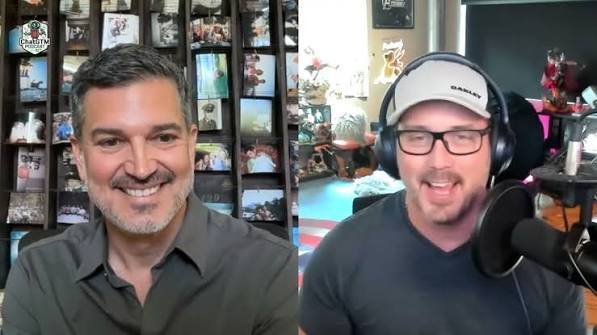
Craftable CEO David Cantu recently joined Michael Beck on the ChatGTM Podcast to discuss margin erosion, sales forecasting, food waste, Operator AI, and why the future of hospitality still belongs to people leaders.
Watch the full episode here.
Forty-five percent of restaurants did not turn a profit last year.
That number sat underneath the entire conversation between David Cantu and host Michael Beck — because it isn't a demand problem or a pricing problem. As David put it, when he went looking for where margin and revenue were eroding, the answer was uncomfortable: everywhere.
David has spent 25 years in the restaurant back office — as an operator and partner, as a co-founder of HotSchedules, as CEO of Black Box Intelligence, and now leading Craftable. He's built back-office software the industry way, by acquiring pieces and stitching them together. He's seen what that produces.
So when he moved from Craftable's board to the CEO seat about a year ago, the team asked a different question:
If we started from a blank sheet of paper, what would we build instead?
Thirty Years of Wrappers
Restaurant back office as a category is 30 to 40 years old. The tool set is familiar: sales forecasting, suggestive ordering, prep and production, labor, recipes, inventory, analytics, log book, task management.
The problem isn't the tool set. It's what's underneath it.
Most back-office platforms in the market today are 10 to 30 years old. The architecture, the infrastructure, the plumbing — none of it was designed to carry intelligence, because intelligence wasn't a consideration when it was built. What followed was a decade of wrappers: a new module here, an analytics layer there, an acquisition bolted on the side.
David has done exactly this himself, and says so plainly. A rollup, an inventory tool folded in, an analytics layer laid on top, learning management alongside it. The business grew. The systems never truly connected.
Then there's the best-in-class approach — pick the strongest point solution in each category. It's a reasonable strategy that produces an unreasonable outcome:
- Every vendor has its own road map
- None of the road maps account for each other
- Nothing flows downstream automatically
- Managers stitch the seams together in spreadsheets
"Most disparate systems are analog. Nothing's automated. Nothing flows downstream."
That stitching used to be somebody's job. Restaurants had an admin in the office pulling invoices together. The admin went away. The administrative burden didn't — it landed on the GM, who is still expected to run a shift on top of it. David named operator burnout as the industry's central pain point, and he traced it directly to years of cutting cost and labor at the operator's expense.
Thirteen Years, Rebuilt in Thirteen Months
Craftable's answer was to rebuild the full stack rather than improve a piece of it. What took 13 years to build is being rebuilt in roughly 13 months, with AI in the architecture rather than layered on afterward — Craftable's own models, not a generalist model patched onto a legacy database.
The team also added scheduling and labor management, with one deliberate decision at the center: the sales forecast drives everything downstream.
Staffing plans. Suggestive ordering. Prep and production.
One forecast, one chain of consequences, one place where a bad assumption gets caught before it becomes a truck delivery or an over-staffed Tuesday.
David is candid that the hardest part is the least glamorous. Item mapping — the six-to-eighteen-month slog of reconciling a dirty item master — is where back-office implementations have always gone to die. Craftable's agents read every item off every invoice, flag anything unknown or unattached to a recipe, and suggest the right mapping based on the operator's most recent and highest-volume purchases. He calls it the final mile of the rebuild.
Where the Money Actually Leaks
Ask where the largest recoverable dollars sit and David doesn't hesitate: ordering.
The culprit is the par level — a static number on a shelf tag, set when nothing was accessible on demand and never revisited. Pars over-order or they stock out, and neither one knows that Saturday is Margarita Day.
Research David cites out of Wharton puts it at 4 to 10% of everything ordered ending up wasted. Industry-wide, that's 33 billion pounds of food waste a year — enough, by his math, to feed 7 million people. And waste compounds: excess product gets turned into a prepped item, which spends utilities and labor on its way to the same bin.
Then there are the costs nobody assigned to anyone:
- Utilities, up 35% over the past six years, measured by no one
- Chemical supplies and paper goods, invisible between counts
- Vodka in the well running heavy on actual versus theoretical — overpour, breakage, or theft
- Price increases absorbed silently because no system flagged the change
Because Craftable reads every invoice for consumption and not just price, it can surface the water bill that ran 600 gallons above the trend and ask whether there's a leak. And rather than boiling the ocean, it concentrates on the highest-value, highest-consumption items — cut actual-versus-theoretical on the top 20 and let the other 150 wait.
David's read on the industry's favorite claim is blunt. The two-to-three points everyone promises back? In his experience, the real number sitting on the floor is closer to 5 to 7%.
The Metric Operators Should Grade Themselves On
Asked for the one metric every operator should understand better, David's answer was immediate: sales forecast accuracy.
Nobody cares how big the forecast is. They care how accurate it is — and almost no one measures it.
The industry standard has been statistics wearing a model's clothing: trailing four weeks for labor, year-over-year for holidays. Craftable runs four probabilistic machine-learning models against each other per location, refreshing every 15 minutes, pulling in geography rather than zip code — a conference downtown, a sporting event, a coliseum three blocks away — plus weather feeds and moving and unofficial holidays. Tested across 2,000 locations, it's landing at a 5% error rate.
The accuracy matters less than the trust, and David was clear about how trust is earned: show the math. Let the operator open the forecast, see why it says what it says, and decide whether to believe it.
A Nervous System, Not a Dashboard
Operators aren't analysts. They never were, and the industry spent 20 years handing them dashboards anyway.
David describes Craftable's approach as a nervous system running behind the operation — nine agents acting as sensory input, reading invoices, sales, labor, and consumption, and surfacing what changed. Operator AI pushes the insight forward. Crafty, the assistant, answers when the operator pulls.
The brain, in his framing, is still the operator. They're the one who knows the walk-in flooded, that the number is a false positive, that the insight doesn't know what they know. When they dismiss something, engineering reads it. When they act on something, the system tracks whether it moved the number and tells them to do more of it.
"Technology should serve the operator, allowing them to focus on what they do best."
The ambition isn't a smarter machine. It's a baseline of performance at every location — because no operator has a rock star in every store, and the system's job is to round out the difference without taking the decision away.
Why Prosper Forum and Prosper Accelerate Matter
The conversation closed on people, and David's conviction that this industry will always be people-led.
Prosper Forum brings hospitality leaders together around becoming better leaders — David first attended as CEO of Black Box Intelligence, and describes walking out more motivated than he walked in. Prosper Accelerate develops the leaders coming up behind them, in cohorts that leave with a network of their own.
He pushed back on the common assumption that Accelerate is about young talent. It's about people who are going somewhere and deserve to be seen getting there — including the ones who aren't the most dynamic person in the room, and who a good leader recognizes anyway.
Asked to finish the sentence — the future of hospitality belongs to leaders who —
People leaders.
Listen to the Full Conversation
Want to hear the complete discussion on rebuilding the back office, margin erosion, food waste, sales forecast accuracy, Operator AI, and developing hospitality leaders?
Watch David Cantu on the ChatGTM Podcast with Michael Beck here.
Craftable is the single back office for restaurant and hospitality operators, unifying invoices, inventory, ordering, and daily profit-and-loss visibility in one system. Operators use Craftable to control food and beverage costs, automate accounts payable, and act on their numbers the same day — not at the end of the month.
Craftable serves hospitality groups including bartaco, Hôtel Swexan, TC Restaurant Group, Woods Coffee, and José Andrés Group.